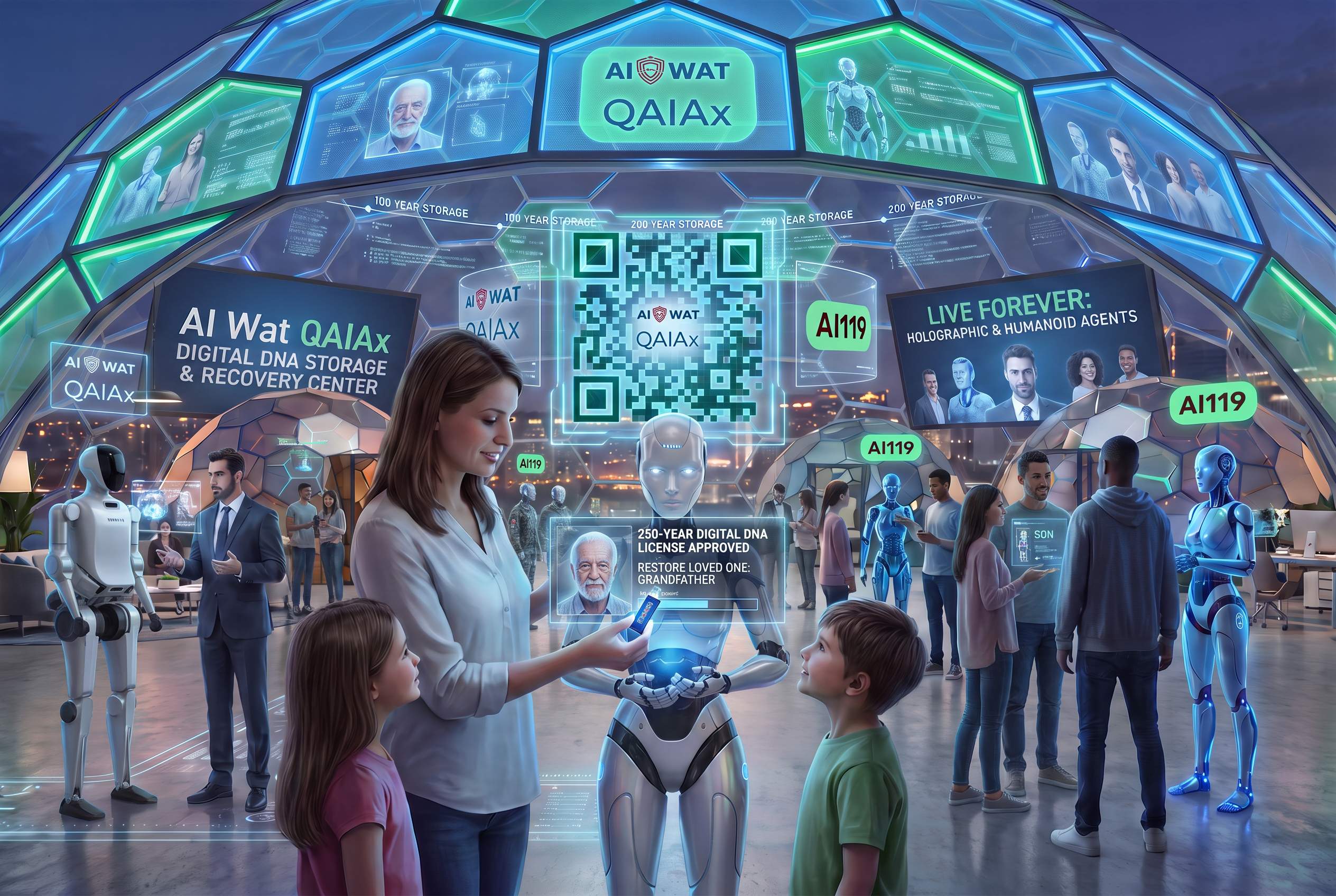
ALEXANDRIA, Va., July 26, 2026 (GLOBE NEWSWIRE) -- A mind-blowing patent application submitted to the U.S. Patent and Trademark Office, by a quantum AI robotics research team sponsored by a veterans organization, working in collaboration with special operations defense and cybersecurity agencies for the QAIAx AI City Hall Project, a federally registered public health clinical trial at the National Institute of Health and National Library of Medicine, is entirely changing what it means to grow old. Following an earlier program announcement regarding a legal pathway for public-use humanoids and AI agents in an international clinical trial on mental and behavioral health, derived from an AI patent technology originally used for military veterans’ claim assistance related to the Camp Lejeune Justice Act—unveiled QAIAx 4E HRR Model Series—a quantum-powered ‘digital DNA’ to install and transfer among humanoid robots built to permanently live alongside humans under a federally registered smart health cities framework.
The QAIAx Clinical Trial & AI City Hall Framework
This groundbreaking rollout operates directly under the QAIAx Clinical Trial (PRS:NCT07661823), a massive health services research initiative managed by the Veterans Recovery Network. The blueprint details a sprawling municipal network of 300 decentralized Microcities built inside sovereign U.S. Federal and Military Enclaves within the U.S. and particular international sites in accordance with bilateral treaties like the Status of Forces Agreement. These smart cities will be engineered to support the authorized 1,000,000 registered resident patients and the ‘smart city’ [enclave] human personnel using a strict 90/10 Hybrid Workforce Model—an AI-friendly global community that affords the majority of living expenses for enrolled residents willing to help evolve the cyber-mind development of agentic robots used for normal life situations.
Under this setup, an automated quantum-computing cloud (e.g., powered by IBM Watson and Google Quantum AI; or Nvidia Vera GPU for offline-intranet activity) manages 90% of all municipal services, including air mixing, water recycling, public utilities, and automated farming. The remaining 10% is governed by licensed human professional auditors who must use secure FIPS 140-3 hardware security tokens to verify data and sign off on complex clinical or administrative anomalies. The clinical trial evaluates participants across 11 specific interventional groups, focusing on conditions such as PTSD, substance use disorders, autism spectrum disorders, and alternative sentencing and re-entry programs for penal institutions.
Cloned Identities: The Multi-Century Price List
Within these automated smart cities, families can achieve practical immortality for their loved ones. Much like keeping cremation ashes, the TDC Model Code licensing engine enables individuals to permanently preserve a parent’s or favorite employee's exact professional and personal identity. While a participant wears an advanced 40-sensor haptic suit, the system maps real-time vitals, motor skills, and expert reflexes into a "Digital DNA" profile.
This asset can be loaded directly into an Omni-AI humanoid robot body or a light-based holographic projection. The profile continues to transfer legally through family estates or corporate trusts, allowing a person's digital self to work, teach, or care for descendants for centuries. The proposed multi-century subscription pricing tiers for this ‘human-robot race’ (HRR) technology license will include:
- 100 Years (Century Tier): $300,000 for multi-generational family or corporate trusts.
- 250 Years (Quarter-Millennium): $600,000 for sovereign entities and large legacy organizations.
- 500 Years (Half-Millennium): $1,000,000 for perpetual family trusts and foundation continuities.
While only time will tell if the human race survives that long, this tech offers logical hope for "cyber-humanity." To ensure fair access, special fee waivers and reduced subscription rates are set aside for disabled military veterans, retired public responders, war survivors, and educators.
Robot Supply Chain Challenge: Wakanda AI vs. China
To build millions of these advanced humanoids without relying on Chinese manufacturing, the project is launching an independent raw material pipeline. Known as "Wakanda AI Metropolis" in West Africa (stretching across Guinea, Sierra Leone, and Senegal) and "AI Oz" in Western Australia, these hubs secure prime sovereign concessions for raw bauxite, working in conjunction with AI synthetic muscles. This massive shift will move production interests away from China, whose motorized robot factories are predicted to face severe raw material shortages and crippling rare-earth capacity bottlenecks over the next 10 to 25 years.
Formally authorized as a recognized defense RDT&E program, the trial's open enrollment pre-launch phase in October, and a clinical trial waiting list for military veterans that opened in July.
Related Topics
QAIAx Clinical Trial Update - Program Press Release (June 26, 2026)
QAIAx (AIhealth4U) - AI Public Health Central: Microcity-A (ClinicalTrials.gov ID NCT07661823)
Active NIH Trial Sponsors Unveil Enhanced Smart City Patent for Near-Future Outer-World Capabilities for Omni-AI Humanoids: (What is Just Like Mars Project?)

A video accompanying this announcement can be found at: https://www.globenewswire.com/NewsRoom/AttachmentNg/dfcd796c-e9dc-4b6d-b55b-6d6b88d3d095
Two photos accompanying this announcement are available at:
https://www.globenewswire.com/NewsRoom/AttachmentNg/1a47dbf5-8acb-48d1-977f-41f0bd4e3919
https://www.globenewswire.com/NewsRoom/AttachmentNg/3b84987f-4efc-49fe-aa10-bb7c43fbce4b

Media Contact:
Derrick Bush
Veterans First For America
[email protected]